
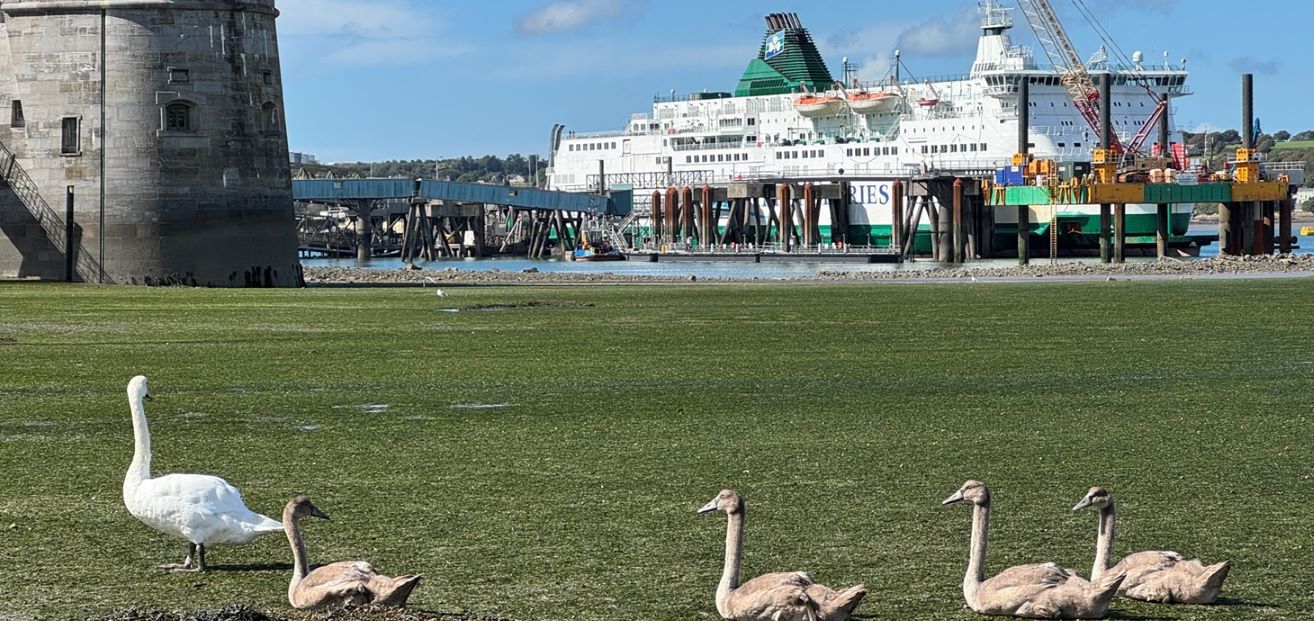
The increasing squeeze between wildlife and human infrastructure means there is now less space for nature.
Picture: Dr Richard Unsworth
A new study has revealed the staggering extent of historical degradation in Welsh estuaries and coasts, challenging modern conservationists to rethink how they restore the nation’s marine environments.
The research, led by Dr Richard Unsworth, of Swansea University, utilises historical ecology to map 300 years of physical modifications. The findings show that 79 per cent of Welsh estuaries (33 out of 42 studied) have undergone major engineering works, including land reclamation, channel rerouting, and the construction of massive embankments.
The study has just been published in journal Natural Resources Forum and its key findings are:
- Widespread modification - more than 13,493 hectares of marine and estuarine habitat have been directly lost to physical alterations;
- The 19th century surge - most major modifications date back to the 1800s, the height of the Industrial Revolution in Wales;
- Systematic removal of vast areas of productive intertidal habitats;
- Vanishing habitats - critical habitats such as salt marshes, seagrass meadows, and oyster beds would have been the earliest and most severe casualties;
- Erased geography - some estuaries were completely removed, and former islands, such as Barry Island, were permanently joined to the mainland through port development; and,
- Problems exacerbated by the vast overexploitation of oyster reefs and persistent metal pollution from mines.
The study argues that because much of this damage occurred before modern ecological recording began, today’s conservation efforts often aim to preserve ecosystems that are already severely degraded.
The report says Wales faces a legacy of degradation with few, if any, 'low-impact' baselines remaining and what remains is not a resilient seascape, but a blank ecological canvas.
Now rather than attempting to return to an unattainable pristine state, the researchers advocate for a One Health restoration framework. This approach focuses on:
- Enhancing biodiversity - moving beyond protecting the status quo to actively rebuilding lost habitats;
- Ecosystem resilience - restoring functions that support biodiversity, carbon sequestration, wave attenuation, and water filtration; and,
- Human wellbeing - linking the health of marine environments to the socio-economic and physical health of coastal communities.
Lead author Dr Unsworth said: "By recognising the true extent of historical change, we can move beyond outdated notions of conservation.
"These degraded ecosystems should be embraced as the foundations for future recovery, ensuring blue growth is aligned with social, ecological, and health outcomes.”
The study is a collaboration between researchers from Swansea University, Project Seagrass, and a local ecological consultant. It saw the research team analysed archival records, Tithe maps, and historical narratives to quantify modifications across the Welsh coast.