
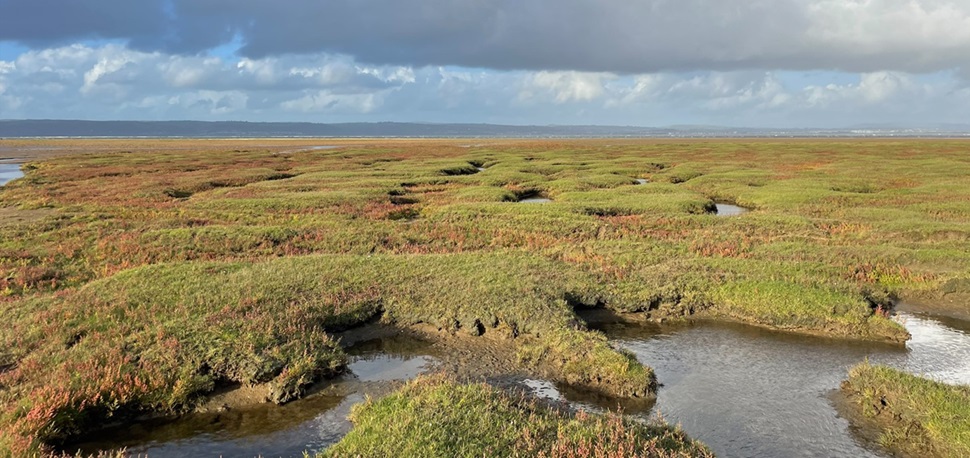
Saltmarshes near Weobley Castle, Gower. Credit: Sasha Shute
Saltmarshes in south Wales support fish at nearly three times the density of unvegetated estuarine shores, according to new Swansea University research.
Published in Estuarine, Coastal and Shelf Science, the study shows the highest fish species richness recorded in a UK saltmarsh and provides the first UK estimates of fish production across natural saltmarsh, restored saltmarsh (managed realignment), and unvegetated shores.
The research forms part of a wider evidence report commissioned by Natural Resources Wales (NRW), which examines how saltmarsh habitats support fish communities and contribute to coastal wetland ecosystem services.
Researchers surveyed 14 sites across the Burry Inlet and Three Rivers estuaries between October 2023 and September 2024, recording 8,525 fish from 21 species using seine and fyke nets, 19 of which were present in saltmarsh habitats.
The team found that:
- Natural saltmarshes support higher fish density, biomass, and production than both unvegetated and managed realignment sites such as Cwm Ivy in North Gower.
- Several species — including Atlantic herring, grey mullet, European flounder, lesser sandeel, three-spined stickleback and sand smelt — were far more likely to occur in saltmarsh.
- Measurable fish production occurred only in natural saltmarsh.
Sasha Shute, who led the study in Swansea University’s Marine Conservation and Ecology Lab (MarCEL), said: "At the time of the study, Cwm Ivy was just 10 years old — relatively young for a managed realignment. It formed naturally after a seawall breach and wasn’t designed with fish in mind, which helps explain the lower production figures. But we were already seeing promising signs, particularly the consistently high abundance of the critically endangered European eel."
Six species were present in saltmarsh throughout the year, including Atlantic herring and European flounder — neither of which had previously been documented using UK saltmarsh as a year-round juvenile habitat. Lesser sandeel, an important prey species for seabirds and marine mammals, occurred exclusively in saltmarsh, marking a newly reported UK association.
Dr Nicole Esteban, Associate Professor in Marine Ecology and Head of MarCEL, said: “Juvenile fish made up 83% of all individuals recorded, underlining the critical nursery role of saltmarshes. Commercially important species such as Atlantic herring and grey mullet were present only at their earliest life stages. These species move between habitats as they grow, highlighting the importance of a well‑connected coastal seascape.”
Angus Garbutt, Principal Ecologist and coastal specialist at the UK Centre for Ecology & Hydrology, added: “Saltmarshes span climates from the Arctic to the tropics, yet we still know surprisingly little about how fish use them. This report makes a valuable contribution by showing that natural saltmarshes support far greater fish density, biomass and production than unvegetated shores or managed realignment sites. It reinforces the need to protect the marshes we have and to accelerate efforts to restore those we’ve lost.”
Saltmarshes are a protected UK habitat under the Conservation of Habitats and Species Regulations 2017 and the Environment (Wales) Act 2016, and interest in their restoration is growing as coastal wetlands continue to decline.
The scale of loss makes restoration increasingly urgent: England has lost more than 85% of its saltmarsh since the 1800s, and a further 5,262 hectares are projected to disappear across the UK by 2060 without intervention.
The new findings provide essential baseline data for assessing the ecosystem services delivered by saltmarsh, from supporting fisheries to enhancing biodiversity and coastal resilience.
Ida Nielsen, Specialist Advisor for Marine and Estuarine Fish at NRW, said: “This research clearly demonstrates the value of saltmarsh for supporting juvenile fish and highlights the differences between mature natural marshes and newer recreated sites. The findings will inform our advice on future marine developments and help guide how we design and restore saltmarsh to maximise nature recovery.”